
Photo credit: Janet Donovan
“Dogfight” is not about the NSA vs. Edward Joseph Snowden, though it could be if you subscribe to the ‘one thing leads to another’ philosophy of life. Silicon Valley provided Snowden with the tech tools needed to operate and expose mountains of classified documents in the first place. Because it’s headline news we asked author Fred Vogelstein what he thought of the situation.
“I don’t think he was a traitor,” he said. “I think if you go back and we look at the whole Daniel Ellsberg Pentagon papers thing … we look at that whole incident with the benefit of hindsight. Granted I was still a kid then, but if my memory serves, there were a lot of people calling Daniel Ellsberg a traitor too …that went on for a for a very, very, very, long time and that there was a pretty good sized debate over it.”
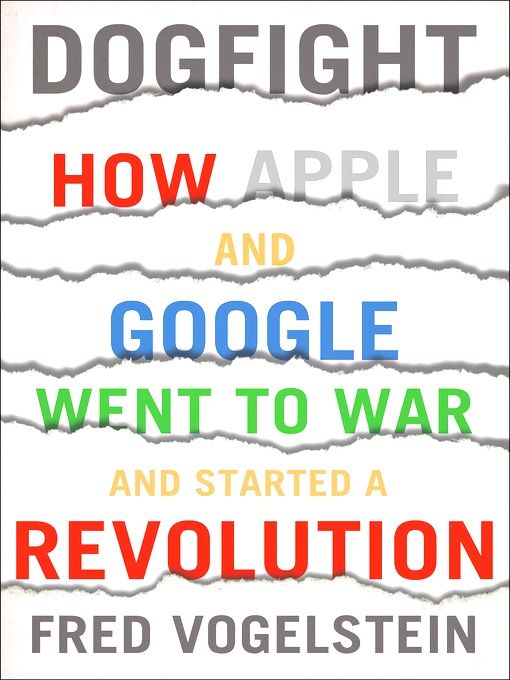
Snowden, who is currently residing in Russia under temporary asylum for leaking NSA documents, is a hero to some, a whistleblower to others, a traitor to many. But the larger point is the evolution of technology that allowed this to happen on a much larger scale than Ellsberg – which leads us to Dogfight: How Apple and Google Went to War and Started a Revolution. These giants of technology have unleahsed no end in sight capabilities.
“At the center of this change is Apple and Google, two companies whose philosophies, leaders, and commercial acumen have steamrolled the competition. In the age of Android and the iPad, these corporations are locked in a feud that will play out not just in the marketplace but in the courts and on screens around the world.
Fred Vogelstein has reported on this rivalry for more than a decade and has rare access to its major players. In Dogfight, he takes us into the offices and board rooms where company dogma translates into ruthless business; behind outsized personalities like Steve Jobs, Apple’s now-lionized CEO, and Eric Schmidt, Google’s executive chairman; and inside the deals, lawsuits, and allegations that mold the way we communicate. Apple and Google are poaching each other’s employees. They bid up the price of each other’s acquisitions for spite, and they forge alliances with major players like Facebook and Microsoft in pursuit of market dominance.” Macmillan

Fred Vogelstein
Vogelstein is currently a contributing editor for Wired in San Francisco but has more than two decades of experience covering business and technology for Fortune, The Wall Street Journal, US News & World Report, New York Newsday and contributing to many other publications writing extensively on the bruising battles among the Silicon Valley’s giant tech companies and the impact of Google, Apple, Amazon and Facebook on the media industry.
Hollywood on the Potomac sat down with the author during his recent visit to Washington. “I did the book because what I realized was that we weren’t just talking about the future of technology, we were talking about the future of media and television. Basically, the phones we carry around in our pockets are mini televisions. More importantly, one of the things that people don’t think carefully about is that at this point, Apple and Google together control probably more eyeballs than the movie studios or the TV networks. They also have more money than anybody else,” he said.
While on the subject of eyeballs, we asked him to comment on the NSA, since they have a lot of eyeballs. “I’m glad that we’re having a conversation about that. I’m glad that Apple and Google, as well as the rest of the tech companies are putting the spurs to the government to free them to talk a little bit more about the relationship that they have. One of the biggest problems that Apple and Google and Facebook and all the tech companies had, when the NSA revelations came out, was that they were legally forbidden from talking about it, yet here you had Edward Snowden talking about all this data.”

We were curious about how he felt about general spying – like the internet collection of data.
“Oh, that doesn’t bother me at all,” he replied, “not in the least. It doesn’t bother me because I actually understand that it’s not a person that’s doing that. It’s just some computer that’s collecting data, churning through data trying to show you stuff. Sure it’s a little weird. One of the things that was funny before this book was published was that they kept showing me ads for the book and reviews from both people who’d reviewed my book well and people who’d reviewed my book not so well.”
We wanted to know what he saw coming down the road, things that we may know about yet from inventors lurking in a basement or garage hammering out the next big thing – something revolutionary.
“I haven’t researched this as much as I would like to,” he responded, “but I had a conversation with somebody the other day about a company called Tile. Tile is a new company that sells small, little, square tiles that are GPS trackers. The thing that makes it really interesting, at least to me, is that first of all these things are small, second of all they’re cheap and you can keep track of them on your iPhone or your Android phone. More conceptually, the thing that I think is really interesting is that because they’re so cheap, people can buy them by the dozens and put them anywhere … You’re worried about your husband …(good for lawsuits)…..you track him. It’ll put private detectives out of business; insurance companies could require it on cars that happen to be parked in high risk areas for being stolen and so on.
Right now, the debate that we’re having is over all that happens online and the digital world. What this stuff has is the potential to do is bringing that debate into the analogue world as well.”

Vogelstein does not invest in tech companies for reasons of conflict of interest. “There’s so many ways for someone to come after me for whatever I’ve written. You don’t want to put yourself in a spot where a company can say ‘We looked at our investor rolls and so and so has been writing all this negative stuff about us, but it turns out that he’s shorting the stock’ or vice versa.”
We asked him to describe his book in one word, one word that describes his experience in digging deep into Silicon Valley. Surprise, shock, awe?
“All of those. One of the things that I found really interesting and one of the things I really wanted to do with the book was to get as much detail as I could to allow people to get a better understanding of how it really works. I was really surprised at how hard it is to build the kind of products that we take for granted. It’s not just a job; it’s kind of a quest. And they work themselves to death sometimes. I didn’t appreciate just how hard it is to come up with products that change the world. It’s really, really, really, really difficult. What you discover actually is that Silicon Valley is very good at making people think that innovation is a straight-line sort of thing. You start over here at the bottom on the left and then it’s a straight line all the way to the top when you release a product. The reality is that it’s not like that at all. It’s messy. It’s filled with failure. It’s filled with political warfare. It’s filled with petty rivalries and jealousies, as well as ideas that fail, as well as ideas that fail that then lead to successes.

One of the things that makes the Valley an interesting place is that failure is actually considered a good thing, rather than a bad thing. Most of us grew up in situations where we spent a whole bunch of time planning to make sure that we get one shot because we felt like if we missed, we’d never get another shot; whereas the Valley is all about trying to set things up so that you plan less, take more shots. They sort of expect that failure is going to happen and that you’re going to learn from failure. Actually, if you go back and look at all the people who have really succeeded in Silicon Valley, most of them have succeeded because they failed. On Wall Street, you’re not supposed to fail. I don’t know government as well, but …I guess what I’m trying to say is people spend their lives at cocktail parties here or you go to a cocktail party in New York and somebody asks you what your last job was or what you’re doing now and if it happened to be a failed startup, you’re going to mumble that. If you’re in the Valley …it’s different. You go to a cocktail party in the Valley and somebody asks what your previous job was and you say ‘I had a startup; it failed. Actually I had two startups that failed’. That often leads to conversations ‘You know, I had one that failed too.’
Most of these startups that fail are not funded to the tunes of hundred of millions of dollars, but certainly to the tunes of tens of millions of dollars. When people fail, it’s not trivial … it’s not that they’re failing in their garage. It’s that they built a company. It lasted five years. They got it down to 50 people and then ultimately had to shut it down kind of failure. I don’t think we’re talking about getting companies to a billion dollars in revenue kind of failure, but we’re talking about getting companies to $50 million in revenue kind of failure. It’s accepted.”
Amongst the tech giants,Vogelstein found Steve Jobs to be the most interesting among the giants of technology – brilliant, if somewhat ruthless.