
by Greek correspondent: Dimitrios Machairidis
Photo credit: © Dimitrios Machairidis
“I was born in 1933 in the middle of the recession. My parents were refugees. They fled from the pogroms in Russia. Between 1939 and 1941 my father listened to the radio. In the room there were whispers about trains taking Jews to concentration camps. We were kids and our parents did not want to upset us too much. But we were very quiet in order to hear everything. I grew up hearing all these stories of communism, recession, injustice, inequality and trains to camps that disturb me even now,” said Sallie Latch, an American artist who participated in the exhibition “A World Not Ours” at the Art Space Pythagorion in Samos, the Aegean Island, facing the Turkish coast.
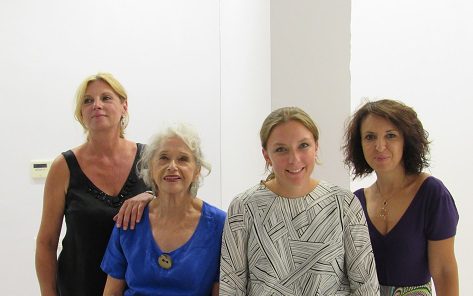
Katerina Zacharopoulou, Sallie Latch, Lena Erhard and Mary Adamopoulou
“I heard the news about refugees in Samos. It was heartbreaking. I checked my Facebook and I saw the photo of a man holding a child with the caption ‘Why isn’t anyone here helping us?’ That really touched me. I did some research and I found the Samos volunteers. I signed up and I came to Samos expecting that I would have direct contact with the refugees. Unfortunately, I got there after the accord of March 20th, 2016, between EU and Turkey. The refugees were locked within the camp. So I interviewed twenty refugees living outside the camp, as they had permit papers. It took me some time to build a relationship with them.” Two narrations, one of a 32-year-old Syrian mother who managed to arrive in Samos with her three children and another of a young Afghan boy who escaped from the war in his country, are the video art exhibits with which Sallie Latch participates in the exhibition “A World Not Ours.”
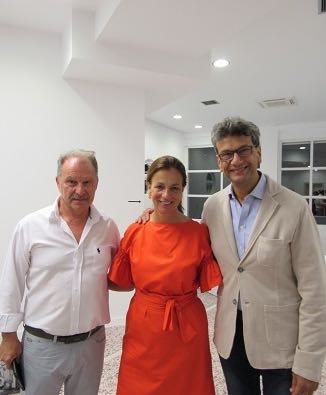
George Kotronias, Chiona Xanthopoulou-Schwarz, Michalis Angelopoulos – Mayor of Samos
Organized by the Schwarz Foundation based in Munich, Germany, the “Samos Festival” attracts some of the most talented artists and musicians to this small beautiful island every summer. The festival takes place around the beautiful ancient port of Pythagorion, one of the oldest in the Mediterranean Sea. It is famous for the Heraion, the enormous ancient temple dedicated to the Greek goddess Hera, and which is one of the most important sanctuaries of ancient Greece. Pythagorion is the homeland of the philosophers Pythagoras and Epicurus and also the astronomer Aristarchos. Today the port of Pythagorion and the Heraion belong to the UNESCO World Heritage List.
“In 2012 we decided to lease from the Port Authority of Pythagorion the hotel built in the port in 1970, which had remained abandoned since 1998. In less than four months we transformed it to the high-tech exhibition hall ‘Art Space Pythagorion.’ It is very important to establish intellectual hubs in Greece like this one we fund in Samos. Greece has one of the richest histories in the world that can help Europe to find solutions to the problems it is facing now, like the refugee flows from Asia and Africa” says Chiona Xanthopoulou – Schwarz, general director of the foundation.
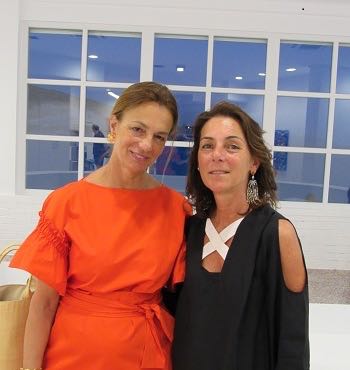
Chiona Xanthopoulou-Schwarz with a friend
“Seven years ago we started with the Young Artists Music Festival that takes place every summer in the ancient theatre on the hills of Pythagorion. Five years ago we added the Art Space Pythagorion. This year we renovated three buildings in the medieval village of Chora, near Pythagorion. These are going to be the rehearsal halls and the dormitories for musicians from Europe and students in Samos. Who does not want to come to a wonderful Greek island to enjoy the unique beaches, to taste the wonderful culinary tradition and to explore the culture in peaceful villages?” Chiona added.
The length of the Mykale strait between Samos and the Turkish coast is 1,430 meters. The Mykale strait is famous since ancient times. In 479 BC during the battle of Mykale the Greeks defeated the Persians. In 1824 during the Greek revolution against the Ottomans the Greeks defeated the Ottoman armada. Today the Mykale strait is the battlefield for the refugees from Syria, Iraq and Afghanistan who try to cross the borders and enter into the European Union.
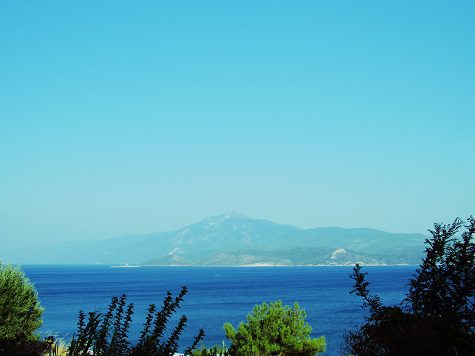
Mykale Strait the Turkish Coast from Samos
“Unfortunately there is just one dimension of the refugees’ image reaching the Greek islands; one of floating near boats and wearing life jackets. This image is just one dimension of the whole risk the refugees take in order to save their lives. Instead of altruism, the refugees’ problem provokes fear. However, a large part of the world population will be increasingly nomadic; a new reality that is caused by wars and economic and environmental factors. This exhibition takes place not in a metropolitan city like Paris or Brussels but in Samos, some kilometers from Turkey, at the borders between Europe and Asia. We selected ten artists who have been involved in the refugee problem for years. Their installations, performances, photo exhibitions and film screenings aim to raise visitor awareness of the problems that refugees face, such as forced displacement, homelessness, perpetual insecurity, diasporic identities and existential limbo,” remarks Katerina Gregos, the curator of the exhibition “A World Not Ours” who is based in Brussels, Belgium.
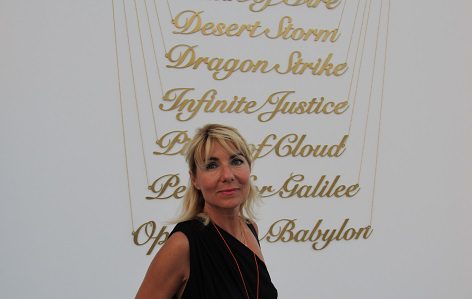
Katerina Gregos curator of the exhibition
“This exhibition is an excellent way of introducing people to the problem of refugees, which our societies tend to ignore. The artists initiate the discussion in an intelligent way because they can see what happens in society well in advance” explained the Argentinian galleriste Victoria Morell and her daughter Sophia who came to Samos specifically for “A World Not Ours.”
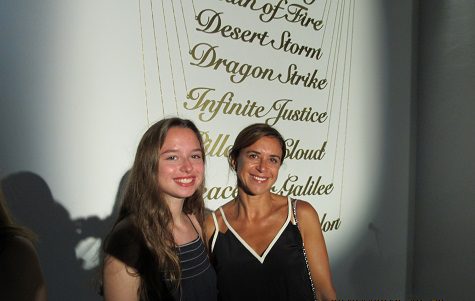
Victoria and Sophia Morell in front of the work TORSO of Ninar Erber
In “A World Not Ours” the artists who participate are: Sallie Latch from the USA, Tanja Boukal from Austria, Roza El-Hassan from Hungary, the Greek Pulitzer Prize winner photojournalist Yannis Behrakis, the Greek photographer Giorgos Moutafis, the Australian-based rap group Juice Rap News, the Lebanese performer Ninar Esber based in France, the film directors Marina Yiotis from Greece and the Palestinian Mahdi Fleifelborn from Dubai, and the installation “Exit” based on a brief by the French urbanist Paul Virillo and created by the American artists and architects Diller Scofildio + Renfro in collaboration with Laura Kurgan and Mark Haansenthat. “Exit” belongs to the collection of the “Fondation Cartier pour l’art contemporain” in Paris.
