
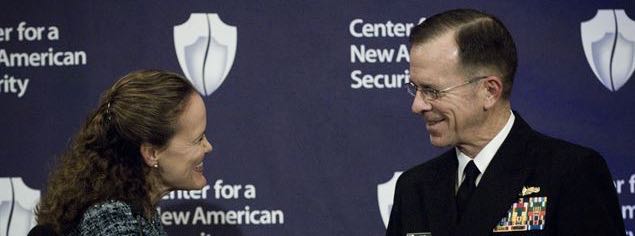
Photo credit: Janet Donovan & CARE
“It’s a tiny investment for Americans that can help prevent conflicts, prevent state failure, help stabilize countries coming out of war – a tiny investment for big strategic impacts. I think tonight’s about making that case.” Adm. Mike Mullen, USN (Ret.) and former Joint Chief of Staff told Hollywood on the Potomac at a dinner in his and Michèle Flournoy’s (CARE) honor at the home of Juleanna Glover and Christopher Reiter. The cause? CARE. Both are concerned about the possibility of fund cutting.

Regine Binet of Bayeux, France, a town not far from the Normandy invasion beaches, receives a CARE package in 1946 – a gift from an American she had never met. Photo credit: Courtesy of CARE
“It’s really about trying to make a strategic case for why development assistance is in United States’ strategic interest. We both served in the Pentagon and there is a national security case to be made for smart, effective development assistance. It’s less than one penny on the dollar,” he added.
Considered one of the most influential CJS as the top military advisor to Presidents George W. Bush and Barack Obama, Mullen is widely recognized as an “honest broker” by policymakers, Members of Congress and senior military officers with emphasis on strengthening the U.S. military and advocating for those who serve. “I think the whole issue of USAID, foreign assistance has been highly politicized in recent years, and there is a strong desire to pull back on that; and thus they’ve chosen to do that. The military can’t do this stuff alone. I’ve been there. It doesn’t work, it won’t work in the future. The more we bleed this area the military is going to bleed in the future in conflicts around the world.” Most recently, he is considered a hero in the LGBT community for telling Congress to allow medical care for transgender troops.
Michèle is co-founder and Chief Executive Officer of the Center for a New American Security (CNAS), a non-partisan think tank dedicated to developing strong, pragmatic and principled national security policies and joined the Board of CARE in 2014.
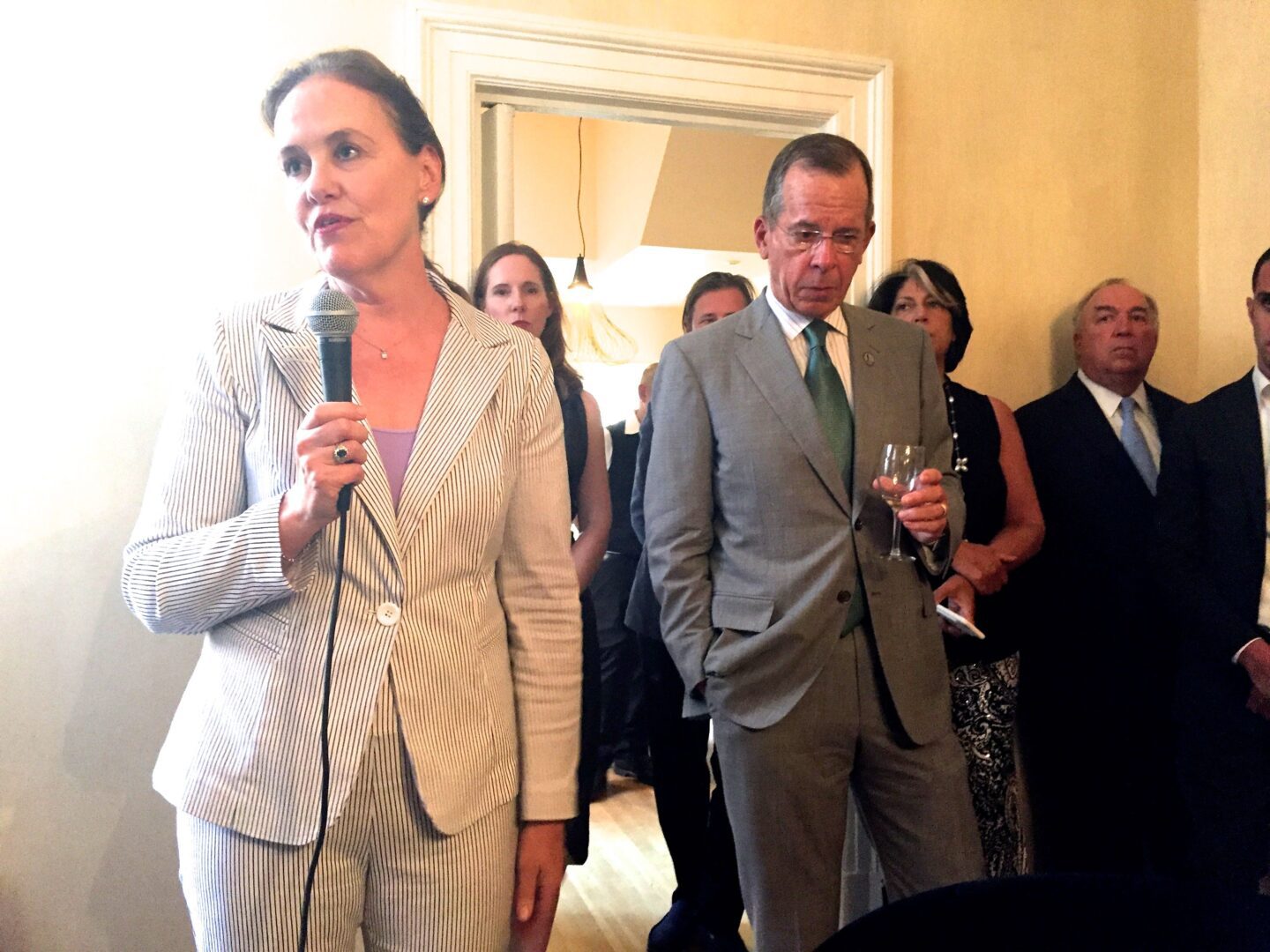
Michèle Flournoy and Adm. Mike Mullen
“We really take a comprehensive look at national security, and when you look at development assistance, it’s really a very key component of the big picture,” Michèle told an attentive audience. “People tend to think first and foremost of the moral argument for humanitarian assistance or development assistance to alleviate poverty, to address humanitarian situations, and so forth, and that is very compelling; but there’s also strategic and national security arguments for development assistance. The strategic argument being there are many, many cases where our early investment in helping to bring a country out of poverty and into greater stages of development has created allies and partners and trading partners for us for many years: Think South Korea. Think of the transformation that a country like India is going through now.”
“And then there are national security arguments,” she added, “where you have situations where development assistance can be part of preventing conflict that would be far more costly in terms of lives and treasure if it were to happen. And also, there are countries coming out of conflict where development assistance is a critical part working alongside of military and diplomacy to stabilize situations, to prevent countries from being perpetual safe havens for terrorists that might want to do us harm and so forth. So the draconian cuts that have been proposed by the administration are really against the United States national security interests in my view. Development assistance is less than a penny on the dollar. It’s a very smart and reasonable investment for the American people. Again, not only out of humanitarian compassion and the desire to demonstrate US moral leadership in the world, but also for the national security perspective.”

“Someone asked me earlier: ‘What are you doing?’ I’d left the government in 2011 after 43 years and one of the things that I do that I love the most is to teach kids at Princeton,” said Mullen. “The course basically is US military power, US diplomatic power, achieving the right balance; and the underlying thesis is it’s become far too easy to use the military, to lead with the military. And as Jim Mattis (United States Secretary of Defense) said, and many of us have said for a long time, is you just can’t kill your way to success in this environment. It’s gonna get harder before it gets easier. And so the national security implications of a cut, of such a significant cut of part of the team – what I call the national security team of obviously the State Department and USAID – will have huge near-term and long-term impacts. They will create growing problems in the long run, and it’s not like we have a lot of focus on the long run these days in this town or in the country, but the destabilizing aspects of it are significant.”
“There’s two sides to this. Certainly we want the programs that are out there that are effective. One of the things that happens in a situation like this is efforts like CARE, that have gotten their money every year really need to be geared up to defend what they’re doing, to defend their programs, and do it in a way that makes sense. What are the most effective? Where would you make choices about where you would spend and where you wouldn’t spend? Those are all important aspects of this. There’s another piece of this before I got into the policy world. I was a budget wonk. That’s how I grew up in the Navy, doing budgets and programs. CARE sent me the latest construct of how this budget is actually being portrayed. It isn’t just the 32% cut in the State Department, but it’s combined with another cut to create a new entity. So you now have a cut from a significant program there in addition to a cut from USAID combined, and what that will do in the arcanery of the budget world is it will basically give budget types license to essentially generate outcomes exactly like they want to do.”

May 12th, 1949. Berlin, Germany. When Soviet troops blockaded Berlin in 1948, the first major crisis of the Cold War ensued. The US responded with the now famous airlift, which included 250,000 CARE packages, 60 percent of all relief sent to the city. Photo credit: Courtesy of CARE
“I like to think, certainly at a high level, that the White House is very much aware of what’s going on, but at detail level my experience is actually in four years as Chairman I went to one budget meeting in the White House for the Pentagon. It didn’t go very well, and we never had another one after that. Someone asked me earlier today how long this is gonna last. My experience is when you cut an outfit 30%, you’re basically just shutting the door. I mean, inside that organization the impact is as if you are closing the door. Nobody knows their future, nobody knows how it’s going to play out. There’s great uncertainty that’s going to be there. I’ve seen a couple of statements from the Secretary saying that we’re basically going to finish the restructure before we know exactly where we stand, and in the middle of what is an incredibly difficult political time, my own view is it’s gonna take four years to sort this out in the State Department alone. They’re working on their ’19 budget right now, ’20s coming right after that, and that’s how this system works. So it was down 30% in ’18, it’s going to be down at least that much in the next budget, and they’re putting that together as we speak. You also need to make your case to those in influential positions that don’t see it the way you see it. Have that conversation. Again, not necessarily a common conversation in Washington these days across the aisle.”
Main slider photo credit: US Dept. of Defense